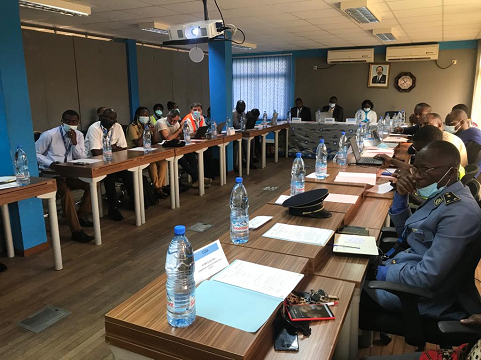
Capacity-building for border control staff
Published: Tuesday, 05 November 2024 12:20


The Delegate General for National Security (DGNS), Mr Mbarga Nguele Martin, presided over the opening and closing of this workshop organized by the International Civil Aviation Organization (ICAO) on October 29 and 30, 2024 in attendance of government members, including the Minister of Transport, Mr Ngalle Bibehe Jean Ernest Masséna, and the Chairman of the Executive Board of the ICAO Public Key Directory (PKD) Commission.

The ICAO Public Key Directory (PKD) is a central repository for exchanging information needed to authenticate electronic Machine Readable Travel Documents (eMRTDs), such as ePassports, electronic ID cards, and Visible Digital Seals.
E-Passports are vital as they are the primary identity documents used in international travel. Their security and facilitation advantages are anchored in the integration of a closed-circuit chip. However, these benefits can only be realized when border control systems successfully authenticate the chip. If the chip is not authenticated at border control, the ePassport offers little advantage over traditional, non-electronic passports. Present at the workshop were the Director General of the Cameroon Civil Aviation Authority, Mrs. Assoumou Koki Paule, and numerous guests and participants from 14 countries in Central and West Africa.
This workshop was organized following the inclusion of Cameroon's passport in the ICAO Public Key Directory (PKD) on June 15, 2022, in Montreal, Canada, and our country's election to the ICAO PKD Commission on November 9, 2023, in Curaçao, Netherlands.
Over the two days at the CCAA Training School near Yaoundé-Nsimalen International Airport, ICAO experts provided essential tools and knowledge to staff responsible for border controls. The goal was to enhance border security while facilitating the movement of people and goods.
To this end, participants learned about the role of the Public Key Directory (PKD) in border control, the security challenges facing various states in the Central and West African sub-region, global trends in document fraud, techniques for detecting it, and the advantages of the Public Key Directory (PKD), along with demonstrations of its implementation and use at border posts.
At the closing ceremony, the Delegate General for National Security, Mr Mbarga Nguele, encouraged participants to leverage the knowledge gained to become proactive players in border control, emphasising training their colleagues in the field.

Cameroon was one of the first countries in Central Africa to introduce the biometric passport. Its inclusion in the PKD allows the Cameroonian biometric passport to be recognized at international airports in member countries. This also enables staff at Cameroon's border posts to automatically verify the authenticity of travel documents presented by nationals of member countries listed in the PKD. Other countries have been urged to follow Cameroon's lead by registering with this PKD, which is essential for internal security. The Director General of the Cameroon Civil Aviation Authority (CCAA), Paule Assoumou Koki, seized this opportunity to reiterate Cameroon’s commitment to achieving high levels of compliance and sharing its experience with other nations.
It is also noteworthy that this workshop was organized as part of the celebrations for the 75th anniversary of the establishment of international facilitation standards. All parties welcomed the event.
Trans: MKG-ARO/PRU